
Can a thin bracket run through the same finish line as a solid steel gear? Can it do this without bending or burning thru it? This question is central to every decision shop owners make about metal finishing equipment.
This piece did not have credentials from a single author. So it is written from a general checked industry view. This is not a story of one person. Metal finishing machines must be able to handle thin and heavy parts. Often this occurs on the same line.
This article covers some essentials. It illustrates how to minimise damage through control settings. It shows which fixtures protect thin sections. It also shows how the finishing needs of farm and construction equipment are different. It also discusses the purchase of used equipment and mistakes to avoid.
What Is Metal Finishing Equipment?
Metal finishing equipment is a set of machines. They clean, smooth, coat or polish a metal part after it has been cut, welded, or cast. This group includes vibratory finishers, shot blast cabinets, buffing wheels and electroplating lines. Some machines also de-burr and take off sharp edges. Others add a zinc or powder coating, which is rust-resistant.
The equipment of the metal finishing process converts a raw part into a finished part. It is ready to go to market. Metal surface finishing equipment can be compact. Imagine a small buffer in a repair shop. Or it can be big. Picture a full queue running many parts each shift.
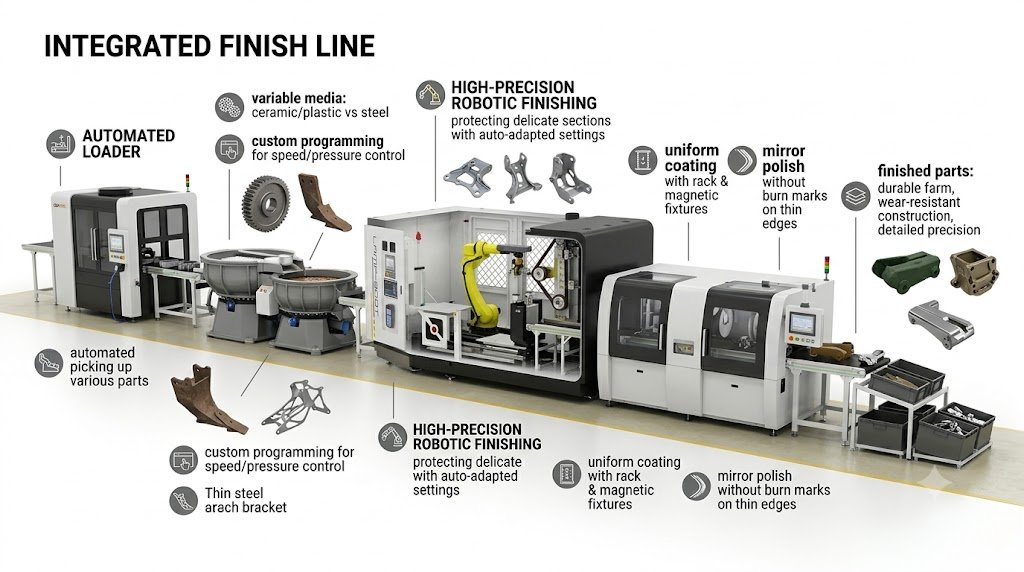
Key Facts About Finishing Machines
| Equipment Type | Primary Function | Common Material | Typical Cycle Time |
| Vibratory finisher | Deburring, smoothing | Steel, aluminum | 20–90 minutes |
| Shot blast cabinet | Surface cleaning, texture | Steel, cast iron | 5–20 minutes |
| Buffing wheel | Mirror polish | Stainless steel, brass | 2–10 minutes per part |
| Electroplating line | Corrosion protection | Steel, zinc die-cast | 30–60 minutes |
How Does Metal Finishing Equipment Control Damage on Thin Parts?
The main ways that metal-finishing equipment controls damage to thin parts are a few: It needs less pressure, softer media and shorter run times. When a part has a thin wall or a weak edge, workers lower these settings. A fixture for a large forging can break or bend a thin sheet metal bracket. Skip this step and you’ll often see more scrap parts, and faster.
Ways Workers Protect Thin Metal Parts
- Lower speed and shorter run times for soft or thin metals
- Soft plastic or ceramic media not hard steel media
- Fixtures to prevent parts from hitting walls of machine
- Sensors that break the cycle if the pressure is too high
- Blast-shot lines with slower belt speed
What Fixturing Methods Keep Delicate Parts Safe During Finishing?
Fixtures hold delicate items. This stops parts from hitting the walls of the machine or each other. For different part shapes custom racks, magnet mounts and split barrels all work best. The best choice depends on part weight, part shape and how many parts are running at once in metal finishing equipment.
Fixture Comparison for Delicate Parts
| Fixture Type | Best For | Advantage | Limitation |
| Custom jig | Odd-shaped brackets | No part-to-part contact | Costs more to set up |
| Rack mounting | Flat panels, plates | Even coating on all sides | Slower to load parts |
| Divided barrel | Small batch parts | Low cost, easy setup | Limited part size |
| Magnetic fixture | Thin steel sheets | Fast to load | Will not hold non-metal parts |
Custom jigs cost more at the start. But they scrap on parts that are expensive to make. Rack mounting flat, simple parts often makes handling them daily easier.
How Do Farm and Construction Equipment Parts Differ in Finishing Needs?
Farm and construction equipment parts are different in some ways. Finishing requirements vary according to part size, outdoor use, and coating thickness. Bigger, tougher parts can often take more abuse. They are less risky than thin light parts.
- Metal Finishing for Farm Equipment
Metal finishing on farm equipment typically needs a thick coating that resists rust. Farm parts sit out in the dirt, rain and fertilizer for years. Tines, housings and brackets are typically large and strong. This enables shops to run at higher blast pressures.
- Metal Finishing for Construction Equipment
For many applications, construction equipment requires a wear resistant coating for metal finishing. These parts are getting gravel, dust and rubbing all day. Hydraulic housings and frame brackets tend to be heavy. Thin-part damage is therefore not as much of a problem here as on light, stamped brackets.
How Do You Choose Between New and Used Metal Finishing Equipment?
Buying new or used gear comes down to a few things. What you make, how much you have to spend and how long you want to run the queue are all factors. Steady, high work often means new gear for shops. They buy it from established metal finishing equipment manufacturers. This benefits them with warranty support and less downtime.
Used metal-finishing equipment for sale is often sought by smaller shops or shops that are trying a new process. Or they search for metal finishing equipment for sale in general. This helps to keep the initial cost down. Much of the metal finishing equipment you see today is in fact new equipment that is 10 or more years old. A well-maintained metal-finish equipment line can last many more years.
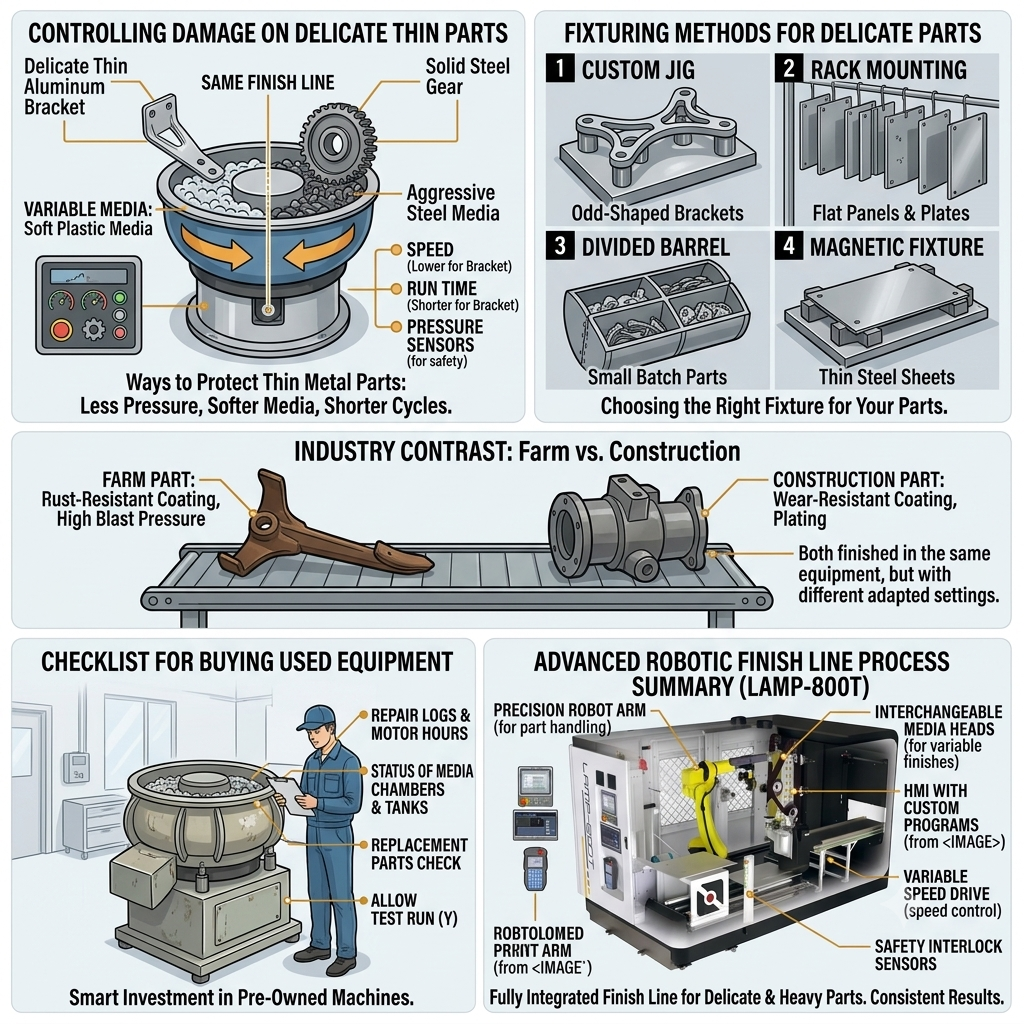
What To Check Before Buying Used Equipment
- Repair Logs and Motor Hours
- The status of the media chambers tanks or blast cabinets
- Can you still get parts for that brand?
- Will the seller allow a test run first?’
What Are Common Mistakes When Finishing Thin Metal Parts?
Most errors come from reusing old settings for heavier parts. A thin aluminium bracket will not be able to stand a cast iron cycle time. This can make the edges too thin or get burn marks.
Another common mistake is to skip a batch of tests. If you run a full batch before checking a single sample part, you risk the whole batch. One wrong setting can ruin everything.
Frequently Asked Questions
What is the best speed setting for finishing thin metal parts?
The safest speed for thin parts is generally the slowest speed which will still clear the burrs. This prevents edges from cracking or becoming too thin.
- Begin with the slowest speed suggested by the maker
- Raise it slowly, and only after testing a part
- If it works, write down the setting so you can repeat it
What is the cost of metal finishing machines?
The costs may be very different. A small bench-finisher may cost a few thousand dollars. A fully automated plating line can cost more than $100,000. The price depends on the size, the weight of the uncoated product and the type of coating.
- Small shop units : cheaper
- mid-size batch systems mid-range cost
- Full-auto lines: most expensive
Can soft metals be damaged by vibratory finishing?
Yes, vibratory finishing can harm soft metals if the media or run time is too aggressive . Softer media and shorter run times are needed for soft metals such as aluminium and brass than for steel.
- Do not use steel media. Use plastic or ceramic media.
- Reduce run time step by step and check parts each time
- Separate soft parts and harder parts from one batch
What is the average cycle time to completion?
Typical finishing cycles are 5 to 90 minutes. That depends on the process and the part shape. Shot blasting is usually the quickest. Vibratory jobs are often the longest.
- Shot blasting 5–20 min
- Vibratory finishing 20-90 minutes
- Electroplating: 30–60 min
What is the difference between polishing and finishing metals?
The complete process of cleaning, smoothing or coating a part is known as metal finishing. Polishing is only part of the job. It gives a shiny look to the part. Not all finished parts are buffed. But every completed piece had to be finished in some way.
Is it worth buying used metal finishing equipment?
Smart purchase can use metal finishing equipment for sale. And the main parts are still in good shape, so this is the case. It’s good for medium workloads or shops with a small budget.
- Check service history before you buy it
- Make sure they still have parts for it
- Save some money in case it needs repairs.
Conclusion
Thin, weak parts require less pressure, soft media and a good fixture. Heavy farm and construction parts usually can take stronger settings. That’s the balancing act that keeps a finishing line low on scrap and low on cost.
If you are in the market for metal finishing equipment, LongLi is worth a look. Its equipment ranges from small bench units to large production lines. This means that shops can match settings to part size, rather than forcing every part through one fixed process.