
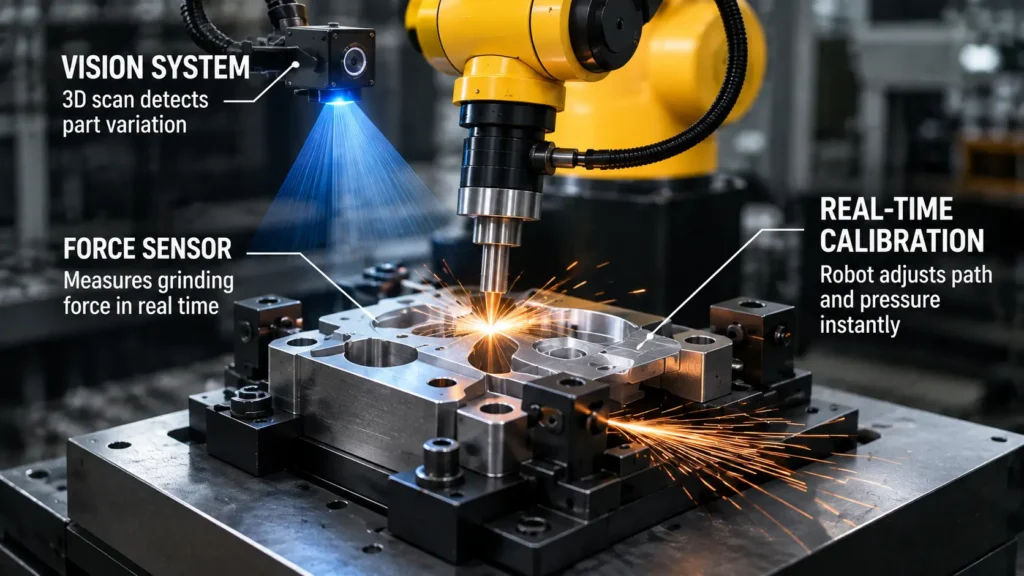
Robotic Grinding Automation Compensates for Part Variation in Three Steps First, a camera looks at the part. Then sensors measure the grinding process. The robot then adjusts its course in real-time.
This is a big deal. No two parts are ever exactly alike. Molds wear out. As it cools the metal twists. Some clamps hold parts differently every time. A robot that follows one path will grind too much in places. It’ll grind other parts too little. Adaptive robotic grinding automation solves this problem. Each piece is taken as a small puzzle by itself.
What Is Robotic Grinding Automation?
Robotic grinding automation involves the use of robot arms to grind parts. It requires little or no human assistance. The robot runs on a fixed course. That path can be out of a CAD file. It can also be derived from sensor data. Some robots repeat the same motion every time. Others change their motion for every part.
This latter type is what people call adaptive robot grinding automation. It uses a standard automated grinding robot and adds cameras and sensors. This allows the robot to respond to the real world in front of it. It doesn’t just respond to the piece on paper.
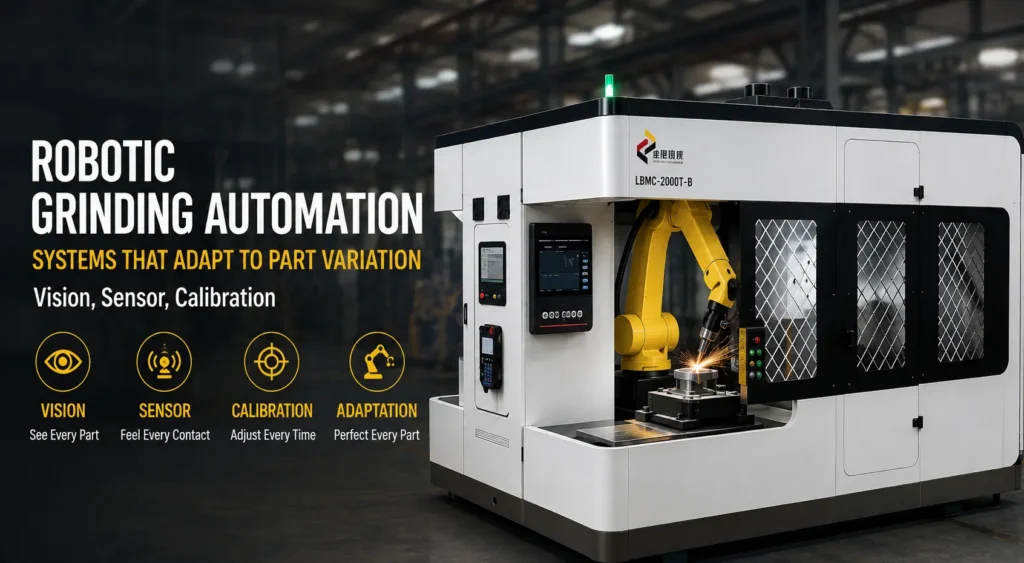
Robotic Grinding Automation At A Glance
| Element | What It Does | Typical Hardware |
| Fixed-path grinding | Repeats one set path each time | Robot arm, grinding tool |
| Adaptive grinding | Changes the path for each part | Vision system, force sensor |
| Vision layer | Spots part differences first | Camera, laser scanner |
| Sensor layer | Checks force during contact | Force sensor, touch probe |
| Calibration layer | Fixes the path as it works | Robot controller, live software |
Why Does Part Variation Break Fixed-Path Grinding?
Robotic grinding machines with fixed paths expect all parts to fit a plan. But casting, forging and welding don’t happen that cleanly. Mold wear can change the shape of a part. And the rate of cooling can change it too. Clamp pressure can also shift it.
Some parts of the cast are out of plane by a few millimeters. Enough for tight grinding jobs. A fixed-path program can’t see or feel that gap. This causes serious problems.
- Over-grinding. The tool removes too much at high spots. This can weaken the piece.
- Under-grinding. Low spots get overlooked. This leaves burrs or rough edges.
- Faster tool wear. Uneven pressure wears out wheels, belts faster.
- More scrap. Found late bad parts. Money and time have been used up.
How Does Machine Vision Help Robotic Grinding Automation See Each Part?
Before grinding each part is scanned by machine vision. It checks the real shape of the part with cameras or laserscanners. The software then compares that shape against the plan. It fills the little spaces between.
The robot uses this gap data to plan its way. The robot builds a new path for only that part. It doesn’t go by a fixed route. Many shops do 2 scans on rough cast metal. A fast scan first locates the part. Then a closer scan checks its exact shape. This second step is most helpful in poor factory light where shadows can hide small edges.
How Do Sensors Measure Robotic Grinding In Real Time?
Grinding tool with force sensors mounted on it. They watch the pressure the entire time the robot is in operation. They don’t just look at it before the job starts. Between the robot wrist and the tool a force sensor is mounted. It reads force many times a second.
Can’t see everything with eyes. A part can appear correct on the outside. But it could be masking a tougher or a softer spot underneath. That secret spot alters the grinding speed. This is detected by real-time sensor data. It follows the real force, not the initial shape. If the force is too great, the robot immediately pulls away. This prevents gouges or burn marks. The same data also monitors the tool wear. A dull wheel will take more force to cut the same amount.
How Does Calibration Correct The Path While It Works?
Calibration provides live path fixes using camera and sensor data. The robot does not blindly trust its first plan. The controller continues to adjust position and force. It is done based on what the sensors are saying at that moment.
Some systems combine a planned path with a constant force objective. This is known as hybrid force control. It maintains the tool at the correct pressure. Studies of robot weld grinding report similar fix-up systems. They fill small gaps between the plan and the real part. These gaps are caused by heat and small part shifts. The speed of a system’s correction is very important. Slow fixes lag a changing part. Fast fixes are closer to the part. But quick fixes require more computer power.
Is Robotic Grinding And Polishing Adaptation The Same Process?
Some tools are common for robotic grinding and polishing. But it’s not the same kind of work. Grinding takes away more material. It also can take a more significant force. Polishing acts on the shine of the surface. It needs a tighter, gentler control.
| Factor | Grinding | Polishing |
| Main goal | Remove material, shape parts | Improve surface shine |
| Typical force | Higher, more varied | Lower, steady |
| Tolerance | Moderate | Very tight |
| Common sensor use | Force sensor, vision | Force sensor, finish check |
Many robotic automated grinding stations do both jobs. They have the same cameras and sensors in both. The part is scanned once. It is ground with greater force. After that it is polished with a lighter force.
What Makes An Automated Grinding Robot “Adaptive”?
The automated grinding robot is adaptive if it can sense the real shape of a part. It has to change what it does next, too. For this you need more than one camera. It takes a few working as a team.
- Real-time / near real-time surface view of the part:
- Force sensing at the point of contact between tool and part
- A live system that adjusts mid-job and not just between jobs
- Software to convert raw sensor data to real path fixes
- Set limits that automatically trigger a re-scan or reject a bad part
If a robot misses even one of these five parts, it is more like a plain robot grinding machine. It has a couple of extra sensors on it.
Where Do These Parts Fit Inside A Robotic Grinding Workstation?
The entire system is a robotic grinding workstation. Inside it vision, sensors and calibration work together. The camera or scanner scans or views the part from above or from the side. The force sensor is mounted directly on the robot’s tool. The controller ties it all together in one loop.
This extra layer takes longer. Scanning and force mapping can add a few seconds to each piece processed. This is more than a simple fixed path run. Shops with lots of parts can often save time. Less garbage they see. They see less rework by hand later. This trade often works for small mixed batches. For a simple part that is made in large numbers, the extra cost may not be worth it.
Common Mistakes When Adding Adaptive Grinding
- For cast parts, there is no scan of the actual part, only the CAD file.
- Forces targets drift with the wheel wear, skipping the tool wear verification
- The camera is placed in a position where glare or shadow from the factory light
- Set too loose force limits and small problems go unnoticed
Fixed-Path Or Adaptive Robotic Grinding
There are three determinants of the right choice. How much do your parts differ? How many are you making? How much is scrap worth? Not all jobs call for full adaptive robotic grinding automation.
- High consistency, high volume: a fixed-path robot grinder will often do the job. It is also cheaper.
- Some variation, mixed batches: vision guided path changes alone can solve most problems.
- High variation, tight tolerance, costly scrap: full vision, sensor and calibration setups usually pay for themselves.
- New or untested part designs: adaptive systems reduce the risk of flying blind on an unknown form.
Compare the extra cost to your scrap rate. They should also compare it with the hand rework time. If scrap is already low, a simpler robotic automated grinding workstation might be the smarter buy.
Frequently Asked Questions
How does robotic automation handle variation in parts grinding?
Three tools allow the adaptability of robotic grinding automation: vision, real-time force sensing and live path fixes. The camera finds where a part is different from its model. The force during grinding is then measured by sensors. The controller changes the path on the fly:
- Gaps in shape observed before contact
- Sensors measure force and material loss on contact
- Mid-job path calibration updates
What role does machine vision play in robotic grinding?
In robotic grinding machine vision is used to scan each part first. It finds gaps in the expected shape before grinding begins. It typically uses cameras or laser scanners. This scan is the first path for that one piece.
- Check position and angle of part on fixture
- Finds highs or lows against the model
- Fixed coordinates sent to robot controller
How do sensors improve the accuracy of robotic grinding?
Sensors improve the accuracy of robotic machine grinding by monitoring the force during the grinding process. The robot tool is equipped with a force sensor. It reads data many times a second. This maintains the pressure even when the surface changes.
- “Pulls back on its own, detects sudden high spots.
- Monitors slow tool wear over many jobs
- Acts as a safety stop if the force gets too high
What is the difference between robotic grinding and robotic polishing?
The difference is in the amount of material taken off, and the amount of force used. Grinding removes more material at higher and varying forces. Polishing is all about shine at lesser constant force.
- Grinding: shaping and deburring, able to handle force variations
- Surface finish Polishing Lower force Tighter control
- Both can use the same camera and sensor setup
Do I need adaptive robotic grinding or will fixed-path work?
It is contingent upon the variation in your parts and how expensive scrap is for you. Fixed path systems are great for steady, high volume parts. Adaptive systems make more sense where parts change often, or scrap costs are high.
- Choose a fixed path for stable, repeat shapes
- Choose adaptive for cast, forged or welded parts with true variation
- Offset the capital spend against your current scrap and rework costs
What industries use the most robotic grinding and polishing?
Top industries include automotive, aerospace, foundry and metal fabrication. The tightest tolerances are usually required by aerospace jobs , like finishing turbine blades . Foundries generally have the largest part-to-part variation. Because castings seldom conform precisely to their CAD model.
- Automotive: deburring chassis and components
- Aerospace : finishing of structural and turbine parts
- Foundry and metal fabrication: clean-up of castings, grinding of welds
Conclusion
Adaptive part variation thru integration of vision, sensing and calibration in a single loop for robotic grinding automation. It is not based on one fixed plan. This loop transforms a simple robot grinding machine into a system capable of handling real, imperfect parts, run after run.
Shops selecting a supplier for this type of project need to pay close attention to how each vendor’s vision, sensor and calibration components work as a whole. Don’t just stare at the spec sheet. And you are looking for a reliable supplier of the machines, and LongLi is. They offer reasonable prices, high quality machines and the best service.