
Deburring a flat edge is simple. A cast part with inner channels and odd curves is tougher, and that’s where many robot systems fail. That’s what people keep asking: Can a robotic deburring really compete with a skilled worker on a tricky part?
This guide discusses robot- deburring as a practical engineering choice, not a sales pitch. It covers what the process is, why hard shapes make it harder, and which sensors and tools are most important.
What Is Robotic Deburring, Exactly?
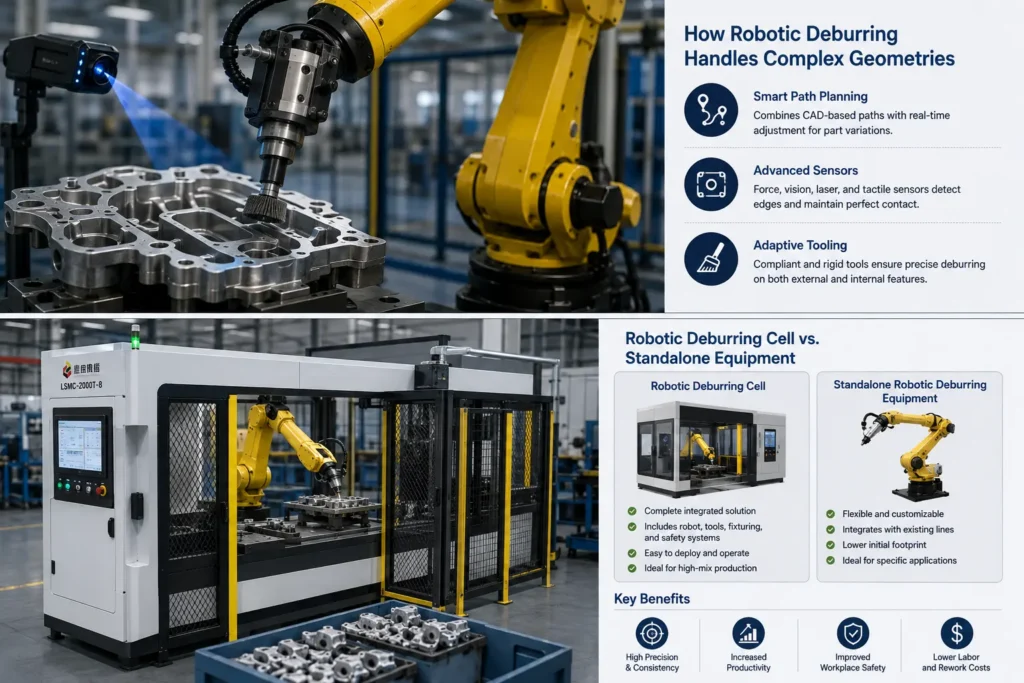
Robotic deburring is the process of removing burrs and sharp edges from a part using a robot arm with a cutting or sanding tool attached to it. These burrs are from 3D printing, casting or machining. The robot performs the same job a person used to do manually, but with a repetitive, set motion.
| Fact | Detail |
| Core job | Removes burrs and sharp edges from parts |
| Common tool tips | Brush, sanding belt, blade, or small router bit |
| Common industries | Cars, aircraft, foundries, general metal work |
| Main benefit | Same pressure and path every time |
- How a Deburring Robot Differs From Manual Finishing
A deburring robot employs the same force and path every cycle. “Your hand has a little different pressure in one part than another, especially after a long shift.
- Automated Deburring and Finishing With Robots
Robots can handle a number of steps in automated deburring and finishing. A single cell can deburr, chamfer and polish a part simultaneously.
- Where This Fits in a Production Line
This step is normally done right after a part is machined or cast. It dulls the sharp edges of the part before a worker touches it.
Why Complex Geometries Challenge These Systems
Hard shapes make this task more difficult as burr size and spot vary from part to part. Burrs the same way every time on a flat, machined edge. A bent or cast part does not.
- A fixed tool angle does not always hit spots because the thickness of the burr varies along a curve with different edge angles.
- Burrs get caught in things like holes and channels, obscuring the view of tools and cameras.
- Even cast or forged parts may vary slightly from the same mould.
- Support material often leaves small bumps on 3D printed parts, and the bumps don’t follow any particular pattern.
Variable Edge Angles and Inconsistent Burrs
A rigid tool held at a fixed angle can leave material on the sharp parts of a curve. This is remedied by a soft and flexible tool head, see below.
Internal Passages and Hard-to-Reach Features
Long, thin tools and small brushes that can reach into holes and channels normal tools cannot get into, nor see.
Cast, Forged, and Printed Part Variability
A robot programmed to follow only a single fixed path might miss burrs that shift slightly from batch to batch. That’s why a lot of systems now use smart sensors rather than a fixed path.
Path Planning: How Robots Navigate Complex Parts
Path planning is how a robot decides where to move its tool on a part . This is most important on hard shapes. One approach dictates a fixed trajectory from a computer model. The other allows the robot to adapt during operation, with live sensor data.
- CAD-Based Toolpaths for Repeatable Geometry
The computer model path works well when each part looks almost the same. The robot learns the route once, then repeats it.
- Real-Time Path Correction for Part Variation
The real-time correction allows the tool to move a little during the job. Sensors send new position data back many times a second.
- Blending Both Approaches
Most modern cells start on a set path, and then let sensors change it. This combines speed with real-world accuracy.
Sensor Technology That Enables Precision Deburring
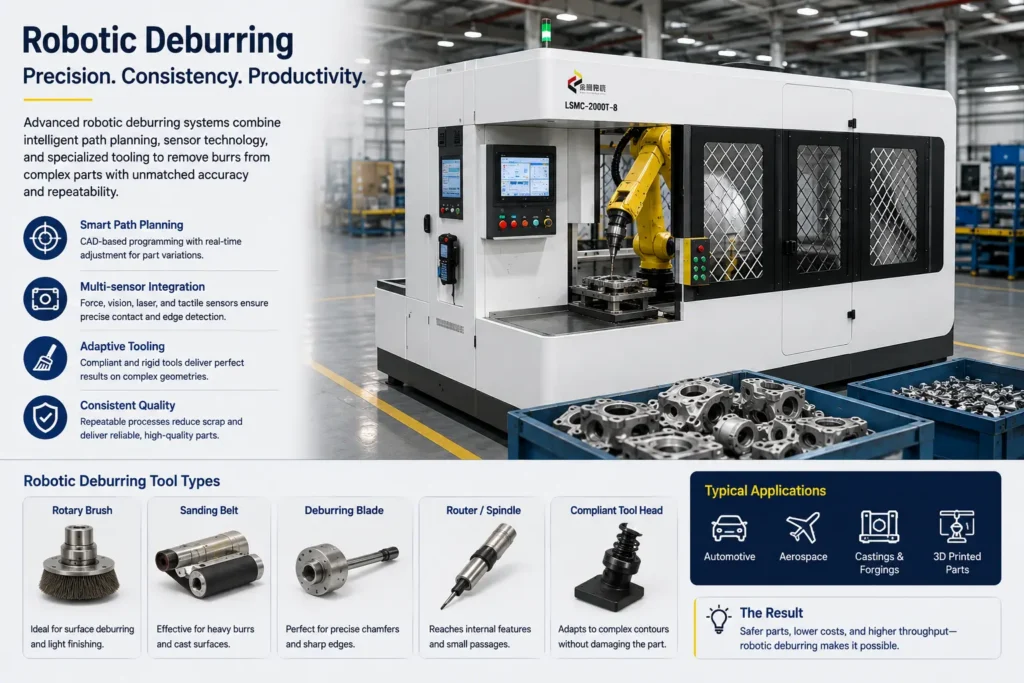
Sensors let robotic deburring tools react to a real part, rather than just repeat a single motion. Each type of sensor helps to find the burr or to control the force of the tool pressure.
| Sensor type | What it checks | Best used for |
| Force sensor | How hard the tool presses on the part | Curved surfaces that need even pressure |
| 3D camera or scanner | The part’s exact position and shape | Parts that sit a little differently each time |
| Laser sensor | The exact edge spot and burr height | Small, fine edges |
| Touch probe | Direct contact with the part | Hidden or inside features |
- Force/Torque Sensing for Contact Control
This sensor prevents the tool from pressing too hard or too soft. If the pressure gets too high the robot backs off by itself. This keeps the thin edges safe.
- Vision and 3D Scanning for Part Detection
Prior to the robot starting, a camera or scanner confirms the actual position of the part. Then it aligns the saved path to the real part.
- Laser and Tactile Sensors for Edge Detection
A laser can find edges very quickly if it can see clearly. A touch sensor is the backup since a laser can’t see tight inside corners.
Types of Robotic Deburring Tools and Tooling
Robot tools for this job fall into two categories. Rigid, stiff tools work best on edges that remain constant. Soft, flexible tools conform to uneven or curved surfaces.
- Rotary brushes for light, uniform burrs on flat or contoured parts
- Sanding belts for larger burrs and smoothing castings
- Deburring Blades For clean sharp chamfers on machined edges
- Small router bits for inside holes and tight places
- Soft tool heads that are spring loaded and bend without gouging the part
Robot Deburring Tool Options for Edges vs Internal Features
Tool changers often have brushed or bladed outer edges. inside features need long thin tools like flex-shafts or air powered spindles.
Compliant vs Rigid Tooling: When Each Applies
Soft, flexible tools perform better if the burr height varies along an edge. Rigid, stiff tools are best for precise, machined parts that vary little from one to the next.
Robotic Deburring Cell vs Standalone Equipment
Robot deburring Cell The complete setup. It has the robot, tools, part holders and safety fencing all built into one unit.” Standalone robotic deburring equipment is added on a piece-by-piece basis to existing lines.
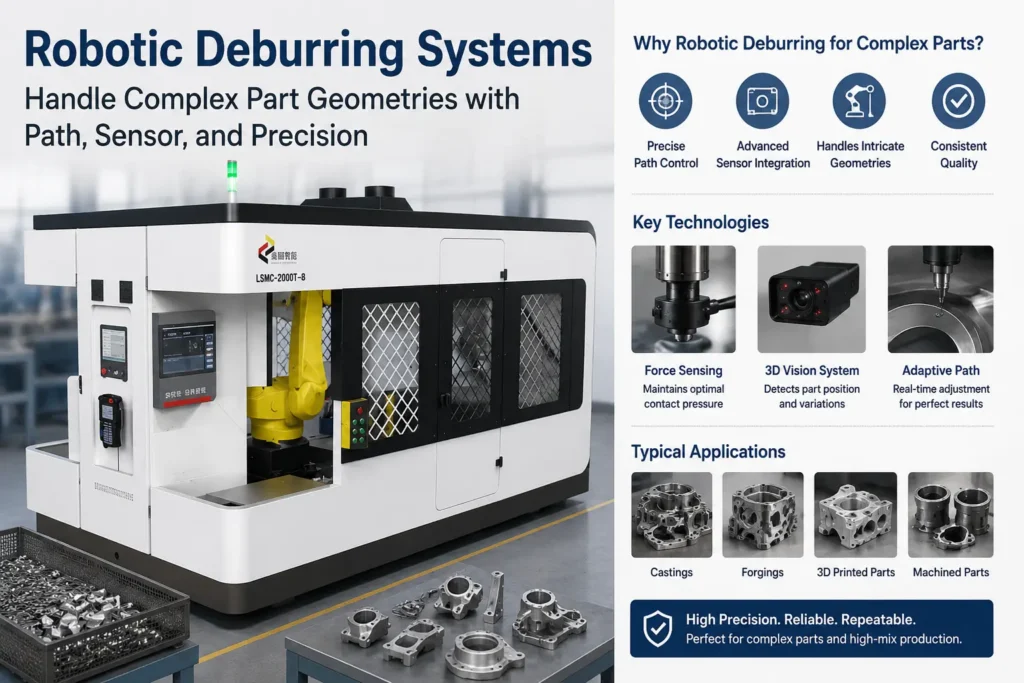
- What a Full Cell Includes
Full cells often hold part holders, tool stations, safety fencing and an integrated camera or force sensor. That’s good for a factory churning out the same few parts over and over.
- Standalone Setups
It’s a stand-alone robotic deburr machine that fits around the gear a plant already has.” It’s often cheaper to start with, but takes more work to get set up.
- Choosing Between the Two
A full cell is good for new lines with lots of part types. Standalone gear is a good fit for a plant that already has good part holders in place.
Comparing Robotic Deburring Systems for Complex Parts
The most different aspects of path-only, sensor-based and hybrid robot deburring systems are accuracy, speed and setup cost.
| System type | Accuracy on hard parts | Cycle time | Setup cost |
| Path-only | Lower on uneven parts | Fastest | Lowest |
| Sensor-based | High, adjusts per part | Medium | Higher |
| Hybrid (path + sensor) | Highest on hard parts | Medium | Highest |
Hybrid systems tend to achieve the tightest accuracy on the hard parts. The path-only setup drifts when a shape changes, while they combine a set path with live sensor correction. But when you consider scrap parts and rework time, that extra cost is often worth it.
How to Choose the Right Robotic Deburring Tooling
Match the tool to the part’s material and shape. Sanding belts work well paired with soft metal such as aluminium. Harder metals need a stiff blade and curved shapes need soft flexible tool heads.
Force control is most important on thin edges and curves. A tool can accidentally cut through good material without it. A little sensor upgrade can save a lot of scrap.
Questions you should ask before buying:
- How much does the burr spot vary from part to part?
- Does the tool need to access features inside the part?
- What cycle time do you need? Does that allow for sensor checks?
- Will a cell need to run more than one part type?
Frequently Asked Questions
Can robotic-deburring handle irregular or organic shapes?
Yes, if the cell is using smart sensors and not just a fixed path. The robot can adjust itself during work with the help of a camera or force sensor.
- Soft tool heads allow more flex on uneven surfaces.
- The odd shapes are the most difficult for a fixed-path-only system.
Which sensors improve accuracy on complex parts?
The most useful ones are force sensors, 3D camera and laser sensor. Force sensors are constantly pressing on curves. Cameras and lasers find the precise edge.
- Touch probes back up sensing on hidden internal features.
- We see more changes in parts with multiple sensor types.
What is the difference between cnc deburring and robot deburring?
A robotic deburr machine is a robot arm with tools that can be changed out. CNC deburring is performed on a fixed axis machine as an additional step in the job cycle of that machine.
- A robot moves more freely across many shapes.
- CNC deburring is more exact with a part already on that machine.
Which industries use robotic deburr cells the most?
The cells are used most by car, aircraft and foundry plants. They run big lots of cast or machined parts that require clean, even edges.
- They are also used by medical device makers for tight finish needs.
- The second common group are the general metal shops.
What is the price of a robotic deburring system?
There’s no fixed price because it depends on the tools and the sensors and whether you buy a full cell or just add-on equipment.”
- A path-only setup is cheaper than a hybrid, sensor-based setup.
- Any rough guess is worse than a quote based on your actual parts.
Do these deburring systems require a skilled operator?
Yes, it requires a trained person to set up and change programs. The hand deburring is more skillful than the day-to-day operation.
- Requires the most know-how for setup and sensor tuning.
- Other than that it’s mostly watching cycles and changing parts.
Conclusion
Robotic deburring works well and also shows the limits of deburring. The real benefit is good path planning, intelligent sensors and the right tools working together.
If you are looking at options then LongLi is worth a look. It offers a wide range of deburring tools and sensor-based cells, designed for real part changes, not just for showroom demonstrations.