
An automated deburring machine easy to run one part all day. Harder is a machine that has to change more than 5 parts before lunch. This is where automated deburring is put to the test. Some shops do small runs of many different parts. Before they buy a machine they ask a fair question: will it keep up? Or does it only work well on one part over and over again?
This article answers that question in plain, simple language. Here’s what you’ll learn:
- What mixed-batch work requires of a machine
- How programs and setup time impact speed
- Which machines adapt best, and where they still lag behind
What Is an Automated Deburring Machine?
An automated deburring machine provides an automated way to remove burrs and sharp edges. It uses stored tool paths and constant steady pressure. No man was required to steer it by hand. The machine follows a saved route instead of a hand tool. It travels at the same speed, and with the same force, every time. Which keeps every part looking like the first to the last.
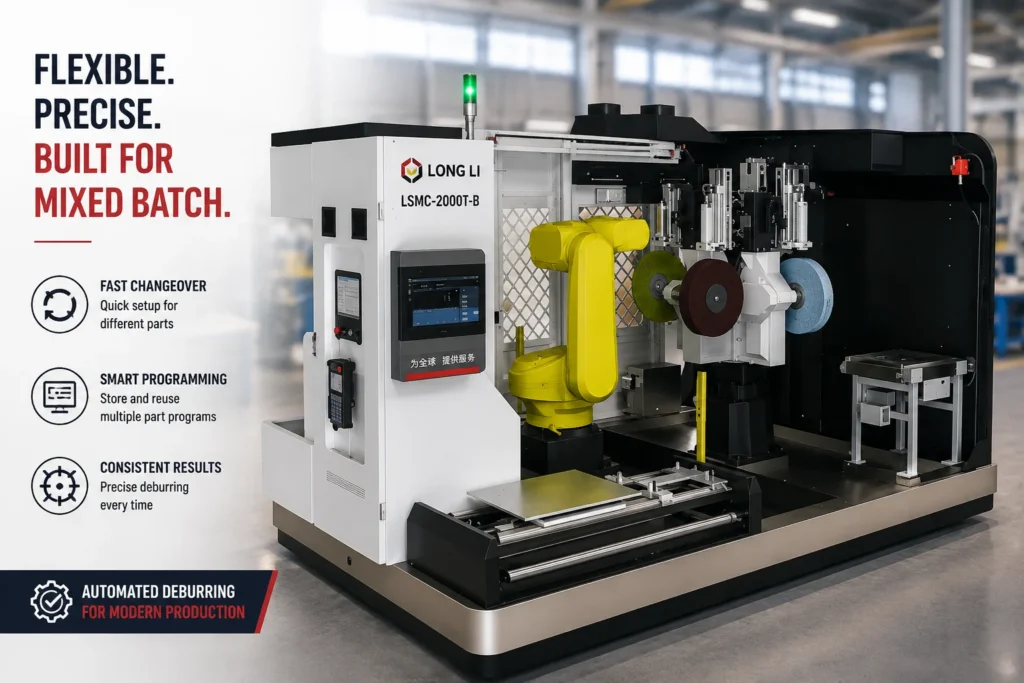
Some machines are simple in that they possess only one tool. Others are full robot cells with several tool changes in a single cycle. Sensors and programs keep the pressure constant throughout the whole run. This is a new method replacing the old outcome determined by the skill of a worker.
Types of Metal Deburring Machines
A deburring machine for sheet metal edges is not the same as a deburring machine for small parts or for tube and pipe ends. Many shops with mixed batches need one machine to do several of these jobs in one shift.
| Machine Type | Common Parts | What Changes Between Parts |
| Sheet metal deburring | Flat, laser-cut panels | Sheet thickness |
| Small parts deburring | Small machined parts, brackets | Fixture, tool head, cycle time |
| Tube and pipe deburring | Cut tube or pipe ends | Diameter, wall thickness |
| Robotic deburring cells | Mixed shapes, small to mid batches | Tool changer, saved program |
Can These Machines Handle Mixed Batches?
Yes. If an automated deburring machine is automated, it can handle mixed batches, provided it has swappable tools and a control system that can store multiple programs. The real question is not can the machine make a new part. It is how fast it can switch to that part, without having to do a full manual reset.
- Flexibility: What Makes a Machine Adapt Well
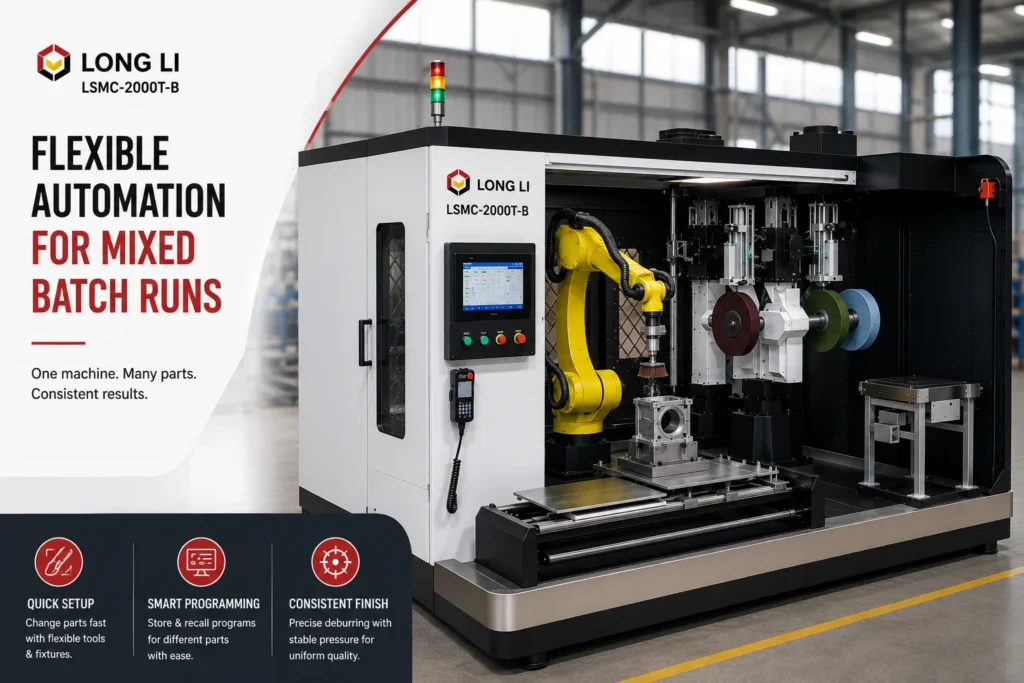
Flexibility consists of two things: interchangeable tools, and saved programs. When a new part arrives, a machine with a fixed tool path is wasted. A machine with swappable tools and saved settings adapts much faster because old setups can be reused rather than rebuilt.
- Programs: Saving and Reusing Settings
Modern control systems can hold more than one part program at the same time. Each has the tool path, speed and pressure that worked before. Rather than starting from scratch, a worker simply selects the saved setting. That’s the main reason why an automated deburring machine is efficient for a wide range of tasks and not just for single part lines.
- Setup: The Real Slow Point
Setup is usually the slowest step, even with good programs. Changing tools, adjusting fixtures and checking calibration all take real time on the floor. That’s where mixed-batch speed is usually won or lost, not in the software.
Small Parts vs. Sheet Metal: Different Needs
Not all mixed batches are alike. A machine for small parts needs another flexibility than one for sheet metal.
Setup by Part Type
- Small parts: lots of tool changes, small fixture changes, quick lot changes
- Sheet metal: less but bigger setup changes; more focus on consistent edges across different sheet thicknesses
- Mixed shops: a machine flexible enough to handle both styles without wasting time
- Fixtures: Quick-release fixtures more important for small parts; sheet handling and alignment more important for flat stock
The takeaway is that it is more important to match the machine to your actual parts than to pick the fanciest option.
What Makes Setup Faster
Good programming alone can’t fix setup time. And the physical design of the machine is equally important.
- Quick-Change Tools
Changing tool holders in seconds saves real time. A job that could take an hour now takes minutes.
- Saved Program Libraries
“Storing tested programs for parts you make often means less trial and error.” Over the years a shop builds up a library of proven settings. Only truly new parts need to be set up.
Choosing a Supplier
Look beyond top speed when purchasing a machine for mixed batches. Most of the speed numbers are based on tests on one single part, not real changeover situations.
Questions to Ask a Supplier
- How many programs can the controller store?
- How long does it take to switch between very disparate parts?
- Can they try it on your parts and not just a demo part?
- What tools are available for parts you have not selected?
Buying From China: What to Check
A lot of the china automated deburring machines in this category are made from the Chinese and are often cheaper. Get test runs on your own parts before you buy. Don’t trust the spec sheet alone.
What Affects the Price?
The price depends on some things: how smart the control system is, how the tools are built, and how automated the machine is. There is no one set automated deburring machine price.
Main Cost Factors
- Program storage- a system where many programs are stored is more costly than a basic one
- Tool swapping- quick-change tooling is more expensive upfront but saves time down the road
- Automation level- cheap stations, more expensive full robot cells
Don’t just compare the price tag, compare these factors against your own parts.
When Automation May Not Be Worth It
Deburring isn’t always an automation answer. It’s important, too, to be honest about its limits.
When It Might Not Pay Off
- One-off parts, very low volume, may not be worth the programming.
- Shops with unpredictable, ever-changing parts may still need manual work
- What matters is not so much how many different parts you make but how often a part is repeated
If a shop rarely makes the same part twice, then the setup time can be more costly than the time it saves.
Frequently Asked Questions
Can a single machine make many different parts?
Yes, and if it can also store programs, as it has swappable tools. Usually if you don’t have them, changing parts means starting from scratch by hand every time.
- Check the control system can save a lot of programs
- Allow tool changes without total recalibration
How long will it take to switch over?
It is contingent upon the machine and the tools and how different the two parts are . Saved programs and quick-change tools speed it up compared to a full manual reset.
- Seek actual switchover times from suppliers, not estimates
- Try it on your own parts not on one demo part
Is it worth it with small batches and mixed?
Yes, a lot – if you see the same parts coming back. Sometimes parts that do not repeat often may not pay off setup cost quickly.
- It’s not the parts you make, it’s how many times you repeat a part.
- Track the frequency of each part returning before making a decision
Small parts vs sheet metal setup ? What is the difference ?
Sheet metal has fewer and bigger setup changes, mainly for edge quality between thicknesses. Small parts have more frequent tool and fixture changes, and they have to be fast.
- Sheet metal: Setup varies with thickness
- little bits: Tool & Fixture change reduces setup time
What’s the price tag on a machine like this?
It is a matter of control system, tools and level of automation. There is no one fixed price. Simple stations are cheap, full robot cells are expensive.
- Request quotes on your own parts
- Compare program storage and tools, not just price
What to Expect from an Automated Deburring Machine Manufacturer
Find one that can actually show you switchover times for things like yours, not just one show piece part. Mixed batches: Raw speed is less important than program storage and tool changeover.
- Ask for references from stores with similar parts
- Demand real change, not estimates over time
Where can I get a mixed production machine?
Price isn’t everything, think about programming flexibility and tool changeover. Ask for a demo with your own parts before you buy
- Use the same test to compare quotes between different automatic deburring machine suppliers
- “Make sure you have enough program storage for the number of parts you actually run.
Conclusion
The real question is not whether a machine can run different parts. It’s the speed at which it can go between them. That speed- via well-built programs and simple tool changes – is the real test for shops that do a variety of work.
LongLi makes automated deburring machine and metal-finishing machines that are designed for this type of quick changeover. Their tools and program storage are ideal for shops that don’t run the same part two days in a row. A demo with your own parts is a smart next step before you choose a machine.